
The Trans-Alaska Pipeline System, often called the Alaska Pipeline, is a monumental feat of engineering that snakes its way across the vast, challenging landscape of Alaska. Mapping its route is crucial to understanding its environmental impact, operational logistics, and overall significance.
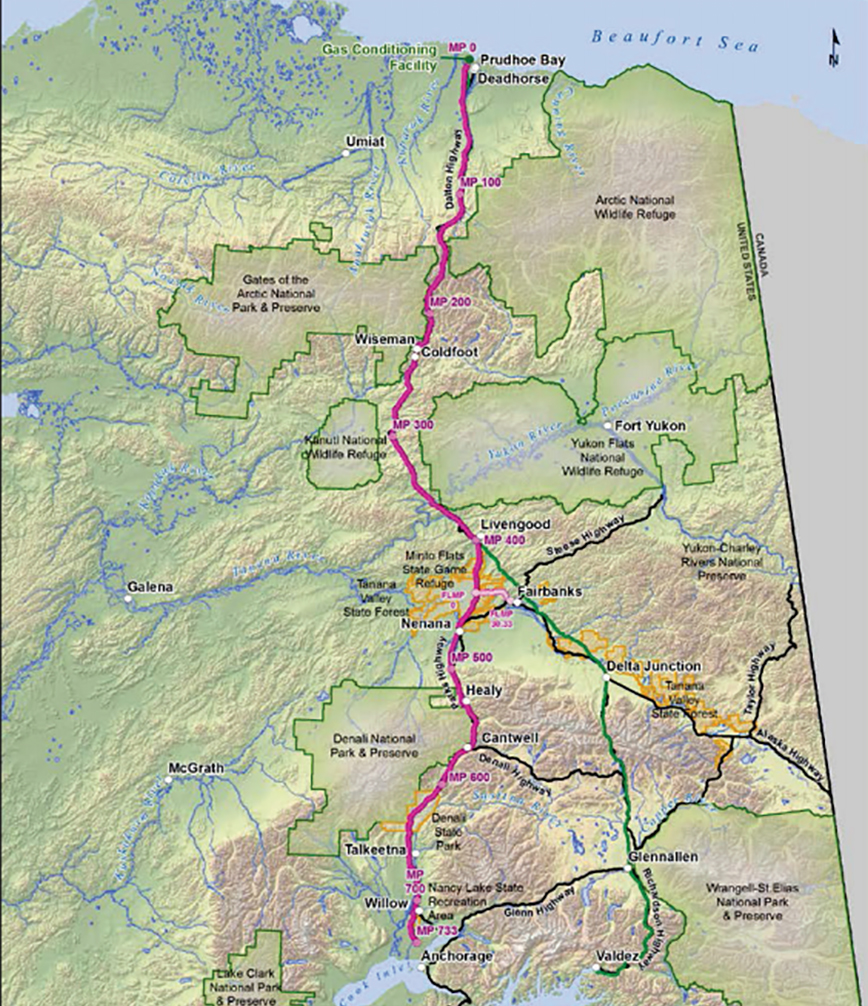
The pipeline’s journey begins in Prudhoe Bay, located on Alaska’s North Slope, along the Arctic Ocean. From here, it travels southward for approximately 800 miles (1,300 kilometers) to its terminus in Valdez, a port city on the south-central coast of Alaska, situated on Prince William Sound. Mapping this route reveals a dramatic traverse through diverse terrain.
Initially, the pipeline crosses the Arctic Coastal Plain, a flat, tundra-covered region characterized by permafrost. This presents a unique engineering challenge as the heat from the oil flowing through the pipeline could thaw the permafrost, leading to instability and potential damage. Consequently, large sections of the pipeline in this area are elevated above the ground on vertical supports. Mapping shows these elevated sections concentrated in the northern portion of the route.
As the pipeline moves south, it ascends the Brooks Range, a rugged mountain range that acts as a natural divide between the Arctic and interior Alaska. The pipeline winds through valleys and over mountain passes, demonstrating the engineering expertise required to navigate such difficult topography. Mapping the route here highlights the careful considerations made to minimize environmental disturbance and ensure the structural integrity of the pipeline.
South of the Brooks Range, the pipeline traverses the Yukon River Valley, a broad, flat region drained by the mighty Yukon River. The pipeline crosses the river using a specially designed bridge, an important landmark along the route. Mapping demonstrates the need for meticulous construction and maintenance in this area to withstand potential flooding and seismic activity.
Continuing southward, the pipeline enters the Copper River Basin, a region characterized by glacial landscapes, including the Chugach Mountains. Here, the pipeline is exposed to harsh weather conditions, including heavy snowfall and extreme temperature fluctuations. Mapping reveals how the pipeline route is carefully designed to avoid active glaciers and unstable terrain, minimizing the risk of damage from glacial movement.
Finally, the pipeline reaches Valdez, its southern terminus. At Valdez, the oil is loaded onto tankers for transport to refineries in the lower 48 states. The location of Valdez, with its deep-water port, is critical for the efficient and safe transport of Alaskan crude oil. Mapping the location of the terminal in relation to Prince William Sound highlights the environmental considerations that went into its construction and operation, especially in light of the 1989 Exxon Valdez oil spill.
In conclusion, a map of the Alaska Pipeline is more than just a line on a map. It’s a visual representation of a complex engineering project that has shaped the economic and environmental landscape of Alaska. It showcases the challenges overcome, the environmental considerations addressed, and the vital role the pipeline plays in transporting oil from the North Slope to the rest of the world.
 800×938 sitnews historic agreement moves alaska gasline from www.sitnews.us
  450×425 trans alaska pipeline system from anupma-prakash.github.io
  1600×1054 favorite views alaska map oil pipeline from myfavoriteviews.blogspot.com
  707×636 map trans alaska pipeline taps source energy information from www.researchgate.net
  930×1200 north oil gas alaska lng pipeline consideration from northof56.com
  488×325 map alaska pipeline from i-tidings.blogspot.com
  730×825 trans alaska pipeline system prudhoe bay alaska valdez alaska from www.wermac.org
  468×388 energy information administration eia from www.eia.gov
  600×450 alaskas trans alaska pipeline transformed states economy npr from www.npr.org
  649×433 geographic analysis trans alaska pipeline system from proceedings.esri.com
  736×804 alaska lng natural pipeline project globe from in.pinterest.com
  850×653 location trans alaska pipeline eastern alaska relative from www.researchgate.net
  728×546 trans alaskan pipeline from www.slideshare.net
  474×511 alaskan pipeline from ar.inspiredpencil.com
  1320×881 alaska from energyandalaska.com
  974×1350 otc alaska oil pipeline flow hart energy from www.hartenergy.com
  300×398 alaska quietly drops trans yukon natural gas pipeline north cbc news from cbc.ca
  1600×2134 alaska vacations travel advice trusted alaskans alaskaorg from www.alaska.org
  250×233 trans alaska pipeline system academic kids from academickids.com
  868×1006 albums pictures trans alaska pipeline system latest from finwise.edu.vn
  711×625 images japaneseclassjp from japaneseclass.jp
  734×742 trans alaskan pipeline system ier from www.instituteforenergyresearch.org
  612×406 alaska pipelines data basin from databasin.org
  620×349 alaska quietly drops trans yukon natural gas pipeline cbc news from www.cbc.ca
  850×560 map trans alaska pipeline system taps scientific diagram from www.researchgate.net
  320×320 landforms route transalaska pipeline system from www.researchgate.net
  5100×3300 trans alaska pipeline system nutshell bureau land management from www.blm.gov
  432×411 crisis fossil fuel mode production critical response from blogs.ubc.ca